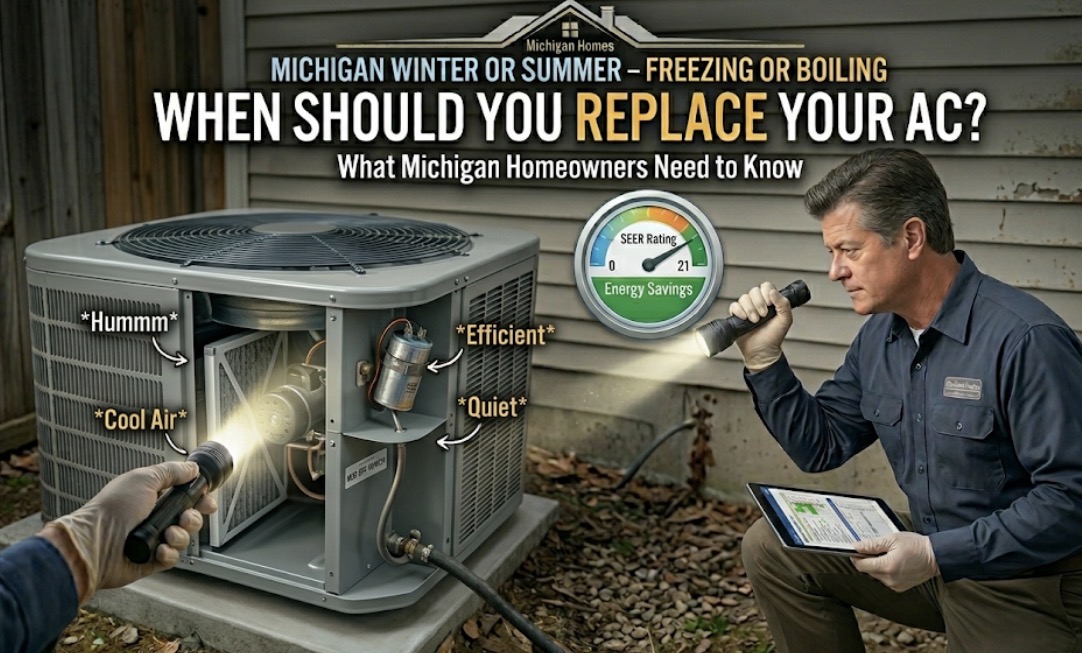
For most of the year, your air conditioner sits idle. Then June arrives, temperatures climb into the 80s and 90s, and everything depends on a system you probably haven't thought about since last August. If that system is aging, underpowered, or losing efficiency, you'll know it fast.
The good news is that the decision to replace an AC doesn't have to be made under pressure. There are clear signals that a system is approaching the end of its useful life, and catching them a season or two early means you get to make the decision on your terms not on a 95-degree afternoon when every HVAC company in Southeast Michigan is booked solid.
How Long Should an Air Conditioner Last?
The honest answer is: it depends on how well it was maintained. Most central air conditioning systems have a designed lifespan of 15 to 20 years. In practice, many systems in Michigan reach the 12-to-15 year mark before their efficiency and reliability drop to the point where replacement makes financial sense.
A system that received annual tune-ups, had its refrigerant levels checked regularly, and ran with clean filters year after year can genuinely reach 18 or 20 years in decent condition. One that was neglected filters changed infrequently, refrigerant levels never checked, coils never cleaned may start struggling at 10 or 11. Age is important context, but it's not the only factor.
Signs Your AC Is Telling You Something
Your Energy Bills Have Been Climbing
This is one of the subtlest but most reliable signals. As air conditioners age, their efficiency declines they have to run longer and work harder to produce the same cooling effect. That increased runtime shows up on your utility bill, often gradually enough that homeowners attribute it to rate increases or unusually hot summers.
A useful check: pull your DTE or Consumers Energy bills from the last three summers and compare usage in kilowatt-hours for the same months. If usage is trending up without a clear change in household habits, your AC's declining efficiency is likely a significant factor.
The System Is Running But the House Isn't Cooling
An air conditioner that runs continuously without reaching the thermostat setpoint is either undersized for the home a problem that exists from day one or it's losing capacity due to age, low refrigerant, dirty coils, or a failing compressor. If this is a new development in a system that used to keep up fine, it's worth having a technician assess what's changed.
You're Dealing With Refrigerant Issues
This is an important one for Michigan homeowners with older systems. As of January 2025, the EPA's mandate requires new AC equipment to use lower-GWP refrigerants like R-454B or R-32. Systems manufactured before this cutoff typically use R-410A, which is still serviceable but is being phased out of production.
What this means practically: if your older R-410A system develops a refrigerant leak, recharging it is still possible today, but costs are rising as supply decreases. A system using R-22 (the older refrigerant phased out before R-410A) is in a more difficult position R-22 is no longer manufactured, and the cost of sourcing it for a repair can approach or exceed the cost of a new system. If your system runs on R-22, replacement is almost certainly the better financial path.
Repairs Are Becoming More Frequent
One repair in a decade is normal maintenance. Two or three significant repairs in two or three years is a pattern and a financially important one. Add up what you've spent on repairs over the past few seasons. If that number is approaching 40–50% of what a new system would cost, you're in territory where continued repair investment rarely makes sense.
There's also the compressor question. The compressor is the most expensive single component in a central air conditioning system. A compressor replacement on an older unit can cost $1,500 to $2,500 or more. If your system is over 10 years old and the compressor fails, replacement of the entire system is almost always the better economic choice a new compressor in an aging system doesn't address the underlying efficiency decline or the other components approaching the end of their lives.
Uneven Cooling and Comfort Problems
A well-functioning AC system should maintain reasonably consistent temperatures throughout the home. Hot spots that persist regardless of thermostat settings, rooms that never quite cool down, or humidity that feels high even when the system is running these can all indicate a system that's losing the ability to properly condition your home's air.
Some of these issues are addressable with maintenance or duct work adjustments. Others reflect fundamental capacity limitations of an aging or improperly sized system.
Understanding SEER2 Ratings and What They Mean for Michigan
When evaluating replacement options, efficiency ratings matter. The current standard is SEER2 (Seasonal Energy Efficiency Ratio, second-generation measurement method), which replaced the older SEER rating in 2023. For Michigan and the northern United States, the minimum SEER2 rating for new residential AC installations is 13.4.
In practical terms: a 13.4 SEER2 system is the baseline. Mid-range systems run 16–18 SEER2. High-efficiency systems can reach 20–26 SEER2. The efficiency premium between a baseline and a high-efficiency system is real but should be weighed against the additional upfront cost and your specific usage patterns. A home in Southeast Michigan running its AC for four or five months a year will have a different payback calculation than a home in Phoenix running it year-round.
For most Michigan homeowners replacing a 10-to-15-year-old system, a 16–18 SEER2 unit in the mid-efficiency range represents a good balance of upfront cost and long-term energy savings.
The Right Size Matters as Much as the Right Model
A common mistake in AC replacement and one that has real long-term consequences is replacing an existing unit with a same-sized one without verifying that sizing was correct in the first place. Oversized and undersized air conditioners are both problems.
An oversized AC cools quickly but short-cycles turning on and off frequently without running long enough to properly dehumidify the air. The result is a home that feels clammy and humid even at the correct temperature. Michigan summers, with their significant humidity, make proper dehumidification especially important.
An undersized AC runs continuously on hot days without reaching the setpoint. Proper sizing requires a load calculation an assessment of your home's specific cooling needs based on square footage, insulation, window area, ceiling height, and orientation. This is a non-negotiable step in a quality installation. If a contractor is quoting you a specific unit size without doing a load calculation first, ask why.
Federal Tax Credits and Michigan Utility Rebates
One factor that meaningfully affects the financial calculus of AC replacement right now is the availability of federal tax incentives under the Inflation Reduction Act. For qualifying high-efficiency systems, homeowners may be eligible for a federal tax credit of up to $600 for central air conditioning. Heat pump systems, which provide both heating and cooling, qualify for credits up to $2,000.
Michigan utilities DTE Energy and Consumers Energy also periodically offer rebates for high-efficiency HVAC installations. These programs change, so verifying current offerings directly with your utility before making a final decision is worthwhile. Combined, federal credits and utility rebates can meaningfully reduce the effective cost of a new high-efficiency system.
The Case for Planning Ahead
The worst time to replace an air conditioner is during a heat wave in July when you have no AC and every HVAC company in the region has a two-week backlog. The best time is late spring or better yet, the previous fall- when demand is low, scheduling is flexible, and you have time to compare options without pressure.
If your system is over 12 years old and showing any of the signs above, getting a professional assessment this spring rather than waiting for a failure puts you in a much better position. You'll have time to understand your options, compare efficiency tiers, and make a decision that considers your budget and your home's specific needs — not just whatever can be installed fastest.